What profit looks like in a Merino ram
Dr Mark Ferguson, Founder, neXtgen Agri
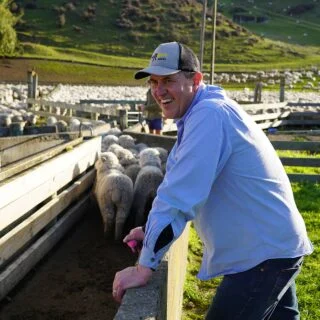
Dr Mark Ferguson on why your eyes mislead you when buying rams, why cost of production drives profit, and how genetic fat makes Merinos cheaper to run.
Dr Mark Ferguson: Thanks, Josh. Thanks, all. It's great to be back in the dome. I've had a long association with Mumblebone, and it's always great to be back here. It's great to have my team here too; we've got James and Amber wandering around, so catch up with those guys. It's great to have lots of clients here as well. We've got three over here from New Zealand, as well as a heap of crew from Australia. So it's awesome to be here, and great to be accelerating what is a fantastic industry in a fantastic place.
My question today is: what does profit look like? Obviously we're all here trying to buy rams that will drive profit. That's got to be our fundamental driver. This is a quote from the last CEO of what was New Zealand Merino when I worked there. It's not his quote, but he used it a lot: what got us here won't take us there. I think that's really relevant for today. Everything we've known to this point about breeding sheep and buying rams changes every year. The sheep you have in front of you today never existed on the planet before this set of sheep.
It's a changing world. It's a really exciting space, but our old knowledge is actually pretty useless, and that goes across lots of our businesses and lots of parts of our businesses. So it's about how we keep embracing that, and how we get ourselves skilled up enough to use this information to our best advantage, so that we're better than the person standing next to us. Not here, but somewhere else. And so we can really take that forward.
I think you'd have to be hiding under a rock somewhere to think the data revolution isn't upon us. We're all using AI to some degree, whether you know it or not. But there's a bit of psychology around the industry which thinks that these breeding values and this data thing are probably a fad and won't take off. That is well down the line now. It's gone so far that we've now got all of you in the room looking through heaps of different data points and understanding them, and that's a really great place to be.
So keep leaning into that. Keep leaning into the information, which is going to get more and more complex, but also more and more powerful for you, because it's a really exciting space we're evolving into in the sheep industry. We've seen that from the two gentlemen who started today. They're both using data fully to really drive their businesses, and that's a really exciting space.
Why our eyes lie to us
I want to start by blowing our minds a little bit, because a lot of what we're doing today is using our eyes, and for about 2 million years that was the only data source we had. We'd wander along, see a sabre-toothed tiger and walk the other direction. That was our data feed. We didn't have any other sources of data, that's the way we've evolved, and that's the way we're still set up. So we have to be really careful about what our eyes are telling us.
We've got two squares there, called A and B. Who thinks they're the same shade of grey? Hands up. Anyone think they're the same shade of grey?
It's contrast. Our eyes are telling us there's a shadow there from that cylinder, and the contrast between these squares is driving a decision that they're a different shade of grey. In fact, they are exactly the same. I've pulled that to bits and checked it on the computer. It is exactly the same shade of grey. I didn't believe it either. Google it if you want.
But when we're walking along this line assessing a ram like this bloke, and then we're assessing the one next to him, if that one happens to be a twin out of a maiden and this one happens to be a single out of a four-year-old, contrast drives our decision. And if you're doing that in your race, with your ewes coming down the race at you and you're pulling off the light ones, the chance of that being a twin out of a two-tooth is way higher than it being a single out of a four-year-old ewe. So be really careful today, and every day forward, about what your eyes are telling you.
The challenge is that vision always wins. Because of those 2 million years of avoiding sabre-toothed tigers, vision is our dominant sense. So if we've got a ram catalogue in front of us with a heap of data and we're looking at something, our eyes keep telling us, "No, don't go near that one. That's a little one. That's a big one. We want the big one." That's why at ram sales and at bull sales, the number one correlating factor, in the traditional sense at least, is live weight. Live weight on sale day is the biggest driver of bull value, and it probably still stands today. It has for every year before today, and that's because vision's winning that game. We have to be better than that. We have to use the information as best we can to avoid what our eyes are telling us.
This is some data from the Merino Lifetime Productivity project that AWI ran. These are professional sheep classers in the race looking at sheep without knowing which are singles and which are twins, and making their keep and cull decisions. In the keeper pen, 70% were singles and 30% were twins. In the cull pen, 70% were twins and 30% were singles. If we just use our eyes, and that's the only information we use, we cull all those twins and then we whinge that Merinos can't count. We have absolutely driven reproduction out of our industry by continuing to use visual cues only.
And what we know is that, well, there's that old saying that 90% of the genetics is what goes down their throat. It's actually about 70%. Roughly 35% of what we see is genetic. The rest is what I call white noise, or environmental impact. For growth and weight traits, it's about 40% genes and 60% other stuff. For ultrasound traits, our fat and muscle traits, it's around 30-odd percent. For our reproduction traits, only 5% of what we see, so whether it was born a single or a twin, is actually genetic. The rest is environmental. So if we just use our eyes, we're in the bad half of our information sources.
All of that is to say that ASBVs are your only way to stop your eyes lying to you. Using what's in that catalogue, and looking at it before you look at the ram, is the only way. I've seen lots of great examples of that today, with people coming through with lists where they've already culled the rams down to the ones that suit their data. That's your only ticket to stop your eyes lying to you.
This is a quote I really like, from a bloke I met years ago in Perth: breed a profitable sheep and learn to like what it looks like. I went onto his website the other day to get that photo and saw he's now breeding miniature donkeys, which kind of deflated my opinion of the bloke. But it's still a great quote, because I think we have these ideas in our heads about what profit looks like, and I know they're worth challenging in your businesses. They might have come from your mother or your father, or from your stock agent, or someone telling you stories about how they have to have long legs to walk distances and all that sort of crazy stuff.
What can you see in a ram?
So, a question for you, and you have to play along, otherwise I'll just stand here silently. There are lots of people looking at rams now. When we're looking at these rams, what cues for profit can we see?
I've got a daughter. I understand awkward silences.
Audience member: Wool quality.
Dr Mark Ferguson: Wool quality drives profit because...?
Audience member: Better price.
Dr Mark Ferguson: Right.
Audience member: Got four legs.
Dr Mark Ferguson: Four legs. That's pretty handy. I've actually counted them all, and they've all got four legs.
Audience member: Fertility.
Dr Mark Ferguson: Fertility. What do I see in fertility? Where did that come from?
Audience member: Multiple births, reproduction.
Dr Mark Ferguson: Oh, so from the data. Yeah. But if I took the cards down, how do I see fertility?
Audience member: I suppose you've got to have two stones.
Dr Mark Ferguson: Two stones. Yep, definitely.
Audience member: Open face.
Dr Mark Ferguson: Open faces are correlated with fertility. Whoever that was, throw that person a hat. Wrinkles, too. I can see fertility because if they're plain-bodied they're more likely to be fertile. I can see open heads, which is about 10 to 15% more lambs. So there are a few things I can see. Any other profit drivers I can see?
Audience member: Feet.
Dr Mark Ferguson: Feet. Yep, big one. That's a great one, and this is a great way to tie up rams. You can walk right along those front toes and right along the backs and have a good look at them. Anything else?
Audience member: Conformation.
Audience member: Size.
Dr Mark Ferguson: Size. That is 60% your eyes lying to you and 40% genetic, so be careful on size.
Anyway, hopefully you're getting the drift that there's lots of stuff we actually can't see, and that's why we're using the data. What you definitely can't see is stocking rate potential. What you definitely can't see is performance under pressure, because all these rams have been running well here, not out the back licking rocks. You can't see disease resistance, except wrinkles, so you can see some fly resistance indicators. You can't see how much labour it's going to take to run these sheep compared with another genotype.
And you can see little things about reproductive potential, but not most of it. You can see some correlates, but you'll see a massive range in the weaning rate breeding values here today, and that's the stuff that's out there to get. People get a bit jumpy when I say 5% of reproduction is genetic and the rest is white noise, but that doesn't mean it's a waste of time. There's actually massive genetic variation in reproduction.
That's the beauty of breeding values: you get what it says on the card. They've already taken the heritability of those traits into account. So what's written there is what you take home. The difference between two rams you have the opportunity to buy is what you actually take home, so you don't have to worry about those heritability differences.
Closing the gap on cost of production
When I look at benchmarking data, every time there'll be a shedding flock, a maternal flock and a Merino flock all up the top. People who choose to do whatever they choose to do in the sheep industry, and do it really well, can all sit in the top 20% of sheep producers. So my question is this. We know Merinos start with a fleece. We can argue about what the value of that fleece is, but I'll put a $70 price on it. Angus will lift that if you buy him a beer or something. Whatever the fleece value is, why do Merinos not sit at that natural high point, given the natural advantage they have in a $70 fleece?
Again, we're doing awkward silences.
Audience member: Reproduction. Lack of lambs.
Dr Mark Ferguson: Right. So reproduction. They have fewer lambs because we culled all the twins. Yep.
Audience member: Growth rate.
Audience member: The productivity per labour unit.
Dr Mark Ferguson: Yep. Right. Excellent. I think it is these things. It's cost of production: the total cost of inputs for lamb and wool production. That's the number one driver in your business. We can try to screw these blokes over for price. Sometimes it works; most times it doesn't. But what we can do on farm is drive down our cost of production, either by driving up the number of kilos out the door or by driving down our costs. That should be your number one job when you're buying rams, driving that equation. We can't control the market as much as we'd like to. Will and Angus are doing the best they can to extract value out of the market and bring it back on farm. But what we can control is that equation.
What I see happening in the industry is that we spend most of our time trying to increase that fleece value gap, to make that $70 into $80, trying to increase fleece weight to drive up that gap further. I don't reckon that's the solution. I think the solution is to close the gap on the other bits that are wrong with the Merino, or what we would say is wrong with it. Close those gaps on cost, on labour, on productivity. There's a much bigger opportunity in closing that gap than there is in trying to eke the next little bit out of fleece weight and drive that little gap further, because that's not giving us an advantage.
If that was giving us the advantage, we wouldn't see people moving into shedding sheep and maternals. We wouldn't have seen that trend if fleece value alone was the driver of profitability. We need to get that balance right. I love wool as much as the rest of you. It's a beautiful product, and it's great to see Merino sheep doing really well. But we have to get that in balance and make sure we're breeding an animal that has high welfare traits and low labour costs.
Why fat matters
What do these things all have in common? What are they all correlated with?
Audience member: Cost of production.
Dr Mark Ferguson: Yep.
Audience member: Management.
Audience member: Genetics.
Dr Mark Ferguson: Genetics. Yep, definitely. That's the beauty of genetics. I'm obviously biased, but everything you don't like about a sheep is heritable, and so we can fix it. Literally everything we think is annoying about sheep is heritable. And the trait that's favourably correlated with all of that is actually fat. It's something I've stood in this dome, and in that shed, and in others before it, and in the office up there, and talked about a fair bit, but I'm going to do it again. It's been 21 years since I started my PhD, which was focused on fat, muscle and growth in Merinos. Fat is correlated with all of the traits that were on that previous slide.
This is a cool stat I only discovered two or three days ago and got all excited about. One megajoule of energy stored on the back of those rams, or more importantly on your ewes running around the paddock, is worth eight times as much as one megajoule of energy stored in your silo. So if that barley in your silo is actually stored on your animals, it's eight times the value, because of the cost of getting it out there, the heat produced when an animal eats that grain, and all those things. So there's a massive amount of value in the fat we can store on animals.
The role of fat in an animal, which goes along with that previous slide, is driving reproduction. Obviously it's a switch for reproduction. It's involved in the immune system. Will's already talked about it being massively involved in eating quality. It's involved with robustness: animals that want to survive and thrive. And it drives their energy requirement, which is why I get excited about it.
We have to make sure we're not overdoing it. We have to get it right in the production system. We don't want to be sending Will a heap of over-fat animals. We've got to get that balance of growth and fat right, so we're actually sending him animals to spec. That's easily done if we get the balance right, and it's why we have really targeted, balanced indexes here to work towards with our ram breeding.
What we're trying to do with fat is basically to lift the good times. I've driven most of Australia in the last six weeks, and there are a lot of good times out there. We've got some feed around, and we're trying to store that on the animal. This is a Mediterranean environment pasture curve, so it's different to around here, but there's always going to be a time of plenty. There's always that spring where we get heaps of feed and can't actually utilise it. It's pretty much free at that point, that feed, and we've got to store it and bring it through to the time when we know the feed's going to dry up and we're not going to have as much around. That's the massive role of fat: keeping them alive with less supplement, but also the ability to drive up stocking rate, because we all know that's a massive profit driver.
Lean tissue versus fat
A few numbers before lunch. You've been sitting around a while, so I won't dwell on this. When things are good, these animals can either lay down lean tissue or they can lay down fat tissue. Protein, muscle and organs can increase, or they can lay down fat, and different genetics lay down those two things differently. It's really cheap for a sheep to lay down protein and muscle: 18 megs per kilogram laid down, versus fat, which takes four times that amount of energy to lay down a kilo.
But again, we're laying this stuff down when feed is basically free. We're growing grass right now that's either going to get eaten by kangaroos or eaten by our sheep, so we may as well feed it down the throat of some sheep. Interestingly, to put on a kilo of wool costs us 88 megajoules of energy. That has never been included in any of the calculations valuing fleece weight. In all of the industry indexes, it has never been properly accounted for. It's been assumed that it just turns up for free, which it clearly doesn't.
So fat's expensive to lay down, but the cool thing is that it's a really great energy depot. When we mobilise a kilo of protein, we only get 5 megajoules back, because it's actually mostly water. With fat, we get basically seven or eight times as much energy back as we do from mobilising lean tissue. Different genetics, going through spring, might have laid down a heap of lean tissue. We see that live weight lift, but it's actually mostly lean tissue, so it's low energy when you mobilise it. You haven't made the most of that spring. You've just stored down a heap of lean tissue, which isn't as valuable as it would be if it was fat.
The other cool thing is that fat costs you nothing to keep. When you lay down fat, it just sits there. Unfortunately, it seems to want to hang around. It basically costs you nothing to maintain a kilo of fat on a sheep, whereas lean tissue costs you megs a day, because protein is always turning over. It doesn't just sit there; it's broken down and rebuilt, broken down and rebuilt. Quite good for livers. That didn't get a laugh yesterday either. And I'm worried about Angus's red wine and wool correlation.
So say we had two different genotypes going through spring, one laying down mostly muscle or lean tissue and one laying down more fat. Ninety days after spring, when we're going into summer, the fatter animal's fat will have cost it no energy to maintain. After 90 days, the lean tissue is all gone, just through maintenance, not through being mobilised and used for something else. Maintaining that lean component of the animal means it will have all disappeared in 90 days. The fat will all still be there if the animal was fed at maintenance through that period. So even at maintenance feeding, we're losing ground by having more lean tissue than fat.
Condition score and lifetime production
What that all plays out like is this. These are all Merino Lifetime Productivity wethers that were studied by Murdoch University. The more we drive up genetic fat, the more we reduce the maintenance requirements of sheep, because lean tissue is expensive to keep but fat tissue isn't. We actually change the megajoules of energy required to maintain those ewes going through that autumn or summer period. The top one there is at 9½ megs, versus 7.6 or whatever. That's almost 2 megajoules of energy per day difference, just to maintain that sheep, keep weight on it and get it to come back through and reproduce again.
That's massive, and that's why I think the value of fat, and the profit that's in fat, is going to be really significant as we pull all these sums together. We've got two ways to do that. We can look at the condition score breeding values on these pen cards or in our books, or we can look at our fat breeding values. Both those things are correlated, and I think you've got opportunities to do both.
That should say ASBV, not EBV; that's the Kiwi version. Each of these dots is a sire in the database with 50 progeny. As the fat ASBV goes up, we get an increasing condition score breeding value. So you can almost use those interchangeably, and it all makes sense: ewes in better condition, doing better and being cheaper to run.
We started off talking about fat as a driver of reproduction, which it is. This is condition score, but it's the same thing. The more condition the animals carry genetically, the higher their genetics for reproduction. There's obviously a massive spread there, and that's why, if you're really driving reproduction, you want to use the weaning rate breeding value that's on those pen cards to select for what you need. You select for the thing itself rather than a correlate of it.
But it all comes together. You end up with a more productive animal, a more robust animal, and you take labour out of the system. I think fixing the things that are wrong with the Merino is all about making it more like a crossbred, and fat is one of the major differences between the two.
We're going to rattle through now. This is playing that out in commercial sheep, when classing ewes. When we're going through our yearling ewes, if they were condition score two and a half at yearling age, this is their lifetime average production per year: 24 kilos produced each year on average. If they were condition score three and a half at the same time as yearlings, and that variation will be in all of your young flocks, on average they produce nearly 31 kilos. So this stuff works commercially.
If you're classing your ewes and you're not condition scoring them at the same time, you're doing yourself a massive disservice. If you're doing it without knowing which are singles and which are twins, you're also doing yourself a massive disservice. Those two things are really critical to selecting your next generation of females, whoever's doing your classing. They're something you definitely want to have incorporated.
Breeding for worm resistance and dags
I'll finish off on the other part that's wrong with the Merino, or that we can fix, and that's our health traits. We're working on a new way of genetically selecting for worm resistance using saliva, which is interesting. I won't go into the details, but come and see me and I can talk about it.
This shows sheep with low worm egg count breeding values maintaining that low worm egg count through the period. I know these numbers are pretty small if you're in barber's pole country, but the same principles apply. They're not needing a drench; they're cruising along being happy.
The other cool part is what's happening on the pasture. Someone was crazy enough to count the worm larvae on pasture. It certainly wasn't me. Pre-lambing, there weren't many larvae on pasture. But post-lambing, because those ewes lost their immunity over the lambing period, there was a massive amount of larvae on pasture where the ewes didn't have genetic resistance to worms, and a lot less in the flock of ewes that did have genetic resistance.
So when those lambs are born and they're out there nibbling on pasture, the ones from ewes selected for worm egg count are not getting hit with many larvae. They're able to continue to grow and thrive, whereas the others are starting to get mouthfuls of larvae, and that starts to reduce their appetite, their drive to eat and their growth. Then you get those wormy lambs coming through at marking or at weaning. So it's one of the great traits we can incorporate into our breeding.
The other one is dag. You'll see it on the pen cards, and there's massive variation in dag. We can take all the costs out through our genetics by using the breeding values, not just the wool ones. Use all the ones that are out there, the ones you've got in your books. I'll finish up there, Josh, and we'll move on.


