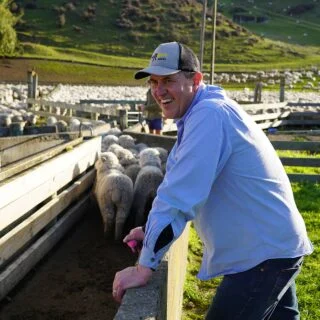
What wool customers are really buying
Angus Street, CEO, Zentera

Zentera CEO Angus Street on how ZQ grew out of New Zealand Merino, what brands really buy when they buy wool, and why listening well pays growers.
Angus Street: Thank you, mate. Firstly, thank you to the Mumblebone crew for having me here. It's an absolute honour. I've got a family connection to Mumblebone, so to be able to come full circle and attend one of these open days is pretty special. I want to start by asking everyone who knows who Zentera is, or has heard of Zentera, to put your hand up. Okay, that's good. Who's heard of New Zealand Merino? I have a few more. Who's heard of ZQ? Okay, cool.
It's always good to know who's in the crowd. I'll start with a little bit around who Zentera is and how Zentera came to fruition. When I was talking to Chad and I said, "What do you want me to talk about?", he said, "It'd be good to understand what the customer's saying, what the markets are saying." And I said, "Okay, cool." I pulled up Copilot, I pulled up some of my own presentations, I pulled up the old New Zealand Merino strategy and then the Zentera strategy.
And I thought, "Why don't I just take you on a journey of how I went through the first three years of being the new CEO of Zentera?" So that journey is what I'll take you through, where I asked lots of questions and tried to get to the nub of the issue and the opportunity.
From Merino New Zealand to Zentera
Before we get to that, Zentera is a 27-year-old organisation. It was founded by a group of New Zealand Merino growers who essentially asked for the industry board, the equivalent of the AWI here, in New Zealand to disband. They took all of the Merino levies from that industry body and set up a private organisation with the focus of creating value for Merino growers in New Zealand. They named it Merino New Zealand, so MNZ was its nickname. For 10 years they marketed Merino around the world on the provenance story of New Zealand.
The big difference was that instead of putting wool into the auction and being a price taker on the day, they adopted the psychology of being a price maker. They started going directly to the fashion and apparel brands and building relationships so that they could supply direct brand contracts. For the first 10 years they ended up having 10 to 15 brand contracts that they would back to back with the growers. That would give growers a level of certainty and security of price and volume. At about that point, 40 to 50% of the growers' wool was going into contract, and they were only exposed to the market for the remainder.
Most of you are wool growers here, and you know that sometimes you send your wool into the auction and it's 50 cents cheaper, then the next week it's up 90, and then it's down again. Wool's one of the most volatile commodities in agriculture, and the New Zealand growers had just got sick of it.
Ten years in, the organisation started hearing whispers from its customers that one of the on-farm practices was quite an issue, and that was mulesing. So New Zealand Merino took the stance to launch the world's first non-mulesed standard and the world's first animal welfare standard for wool. That was called ZQ at the time. Don't ask me what it stood for. We now have an answer: it stands for Zentera Quality. But back then it was two letters that a marketing person came up with, and we started to sell ZQ around the world.
Three years into that transition, 75% of the New Zealand Merino flock had moved from mulesing to non-mulesing. A couple of years later the New Zealand government mandated that all sheep were to be non-mulesed. So we were one of the first countries in the world to lead that transition and support Merino growers through it.
From there, brands started to look beyond just animal welfare. They started to consider the environmental impact and the human impact, and the standard has evolved over the last 15 years. About six years ago we got to a point where we had outgrown New Zealand. Essentially 75% of the Merino wool was coming through New Zealand Merino by then, so NZM, not MNZ, and we had to go to different countries to be able to meet our demand.
So we've expanded to Australia and South Africa. We currently have 1,000 farms certified as ZQ or ZQ Plus. ZQ Plus is our regenerative standard, which is an extension on top of our animal welfare standard, ZQ. About 550 of those are in New Zealand, about 200 in Australia and around 350 certified in South Africa. That makes us one of the world's largest suppliers of ethical wool.
We currently supply 120 brands globally through direct or indirect contracts. Direct contracts are where we've got a back-to-back contract with a brand like Icebreaker, which you'll hear about from Chad. Smartwool. We just brought on board Kathmandu. We've just brought on Patagonia; we haven't made that public yet, but we've just signed an agreement with Patagonia. We supply IKEA, Gucci, Prada, Loro Piana, and the list goes on.
We're working to build some brands here in Australia. In New Zealand there's a huge amount of adoption with some of the domestic brands, but not a huge amount here in Australia, typically because it hasn't been a focus for us. Most of the 120 brands are operating in Europe, Asia or the US. So it's a massive supply footprint and a massive demand footprint.
As I said, some of those contracts are direct off-take agreements and some are indirect. With the indirect ones, we will buy the wool, we will process that wool either into a top or into a yarn, and then the brand will buy it halfway along the supply chain. So it's quite a complex business, but one that's been really interesting to get my head around.
What are our customers actually buying?
That's the journey I've been on, given that I was pretty new to the wool industry. I was emotionally tied to it and connected to it through my family history, but I'd never worked in the wool industry. What I started with in the first six months, and continue to come back to, is this question: what do you think our customers are actually buying? Our customers being on the demand side, not the supply side. Will asked it for meat; I'm going to ask it for wool. What do you think our customers are actually buying?
Audience member: Quality.
Angus Street: Quality?
Audience member: Uniformity.
Angus Street: Uniformity?
Audience member: Story.
Angus Street: Story?
Audience member: Comfort factor.
Angus Street: Comfort factor? The answer's the same as Will's: everything. Actually, how we think about it is that yes, they buy the wool per kilo, absolutely, but every customer we work with buys it because it enables them to deliver something. That something could be a risk mitigant, it could be a differentiator, it could be a story or a marketing tool. In the simplest terms, it enables them to do something.
For us, we think about the value equation, and there are two sides to it. The first side is the customer, and that is value creation. Does the customer create value by buying ZQ or ZQ Plus wool, and what can they get out of the value that has been created? The other side is essentially value extraction. We've got to create enough value for our customer, the brands, to get something out of it for us to share in.
Now, we've got to do that at scale, but we've also got to be bespoke, because we operate across multiple different fashion and apparel markets. We're working with IKEA, supplying 34-micron wool into that market through an Indian supply chain. That's a lot different to selling wool to our Italian spinners, who put it into suiting fabric that goes into Loro Piana, Gucci or Prada, or that 18.9-micron fleece that goes into performance apparel.
Now, that's a tricky one, because with performance apparel, if we're supplying the US, 18.9 is fine, but if we're supplying China, 18.9 is too itchy. So we've got to get 17 and 16 micron. We actually have to work with a multitude of different brands, segments and geographies.
A long and volatile value chain
Which then goes to the question of who we are selling to. The thing that blew me away about the wool industry is how long the value chain is. From the moment the bale leaves the shed to when it lands on the shelves, it's anywhere between 12 and 18 months. It transitions five or six different times. It is one of the agricultural commodities that changes form the most before a consumer picks it up and writes a cheque for it.
What that means is there's a massive disconnect between the prices consumers are willing to pay at a certain period and the lag effect that has on the market, and that drives the volatility. At every stage in the supply chain they've got a different demand and a different request. For top makers, it's really about keeping their machines running. For spinners, it's about quality because of breaks. For fabric makers, vegetable matter is massive, because if you have any seed in the fabric they have to cut out metres and metres of it. So at every stage along the value chain, all of the data that we capture at an on-farm level, the 15 or 16 different data points, have to be factored in.
But for us, the most important customer is actually the consumer. We sell to fashion brands and apparel brands, but the consumer and their discretionary spend is the lifeblood of the apparel sector. Period. There's a massive correlation between red wine consumption and the wool price. There's a slight lag to it, but essentially when the economy's good and everybody's sipping on red wine, everyone's got a fair bit of cash in their back pocket and they're going to go out and buy another jumper.
Now, I have to say the wool price is up at the moment and red wine consumption is down, so that metric probably isn't a great one. I think that's a health and wellness trend, and it might be a generational trend, so we'll have to pick a new metric.
Hearing is not the same as listening
What I learned early on is that hearing is not the same as listening. When you're sitting down with all of these different touch points along the value chain, doing the customer research, you hear things like "Wool's too expensive", "Wool's too hard to use", "It doesn't give me the performance", "It doesn't blend well with this fibre choice", or "That jumper is too itchy."
What you start to unpack is the question behind the question. You would all have heard of the iceberg model. Sitting above the water, people are throwing sticks and stones and giving all the reasons why they don't want to use wool or buy wool. But underneath, there's a bunch of motivations driving them to say that. It could be: "Wool is such a complex fibre. I don't know how to use it. We don't have the expertise internally. I'm actually petrified about the animal activists. And I've got my compliance officer internally telling me I can't use animal products."
So what we have to do is step through all of the bits and pieces that niggle away at our brands and guide them through all of their concerns. If we had only heard, we'd be doing a bunch of different things that we typically weren't, and I don't think the business would be as successful.
I thought I'd share a couple of examples where this has worked, because there are some really important lessons in them about how Zentera operates. In 1985 Coca-Cola was struggling against Pepsi. They made a decision to change their formula, their taste. They went out and surveyed 200,000 customers and asked one question: which drink tastes better? Overwhelmingly, the feedback was that people liked the new Coke formula. So they threw out the 99-year-old recipe and launched New Coke, to complete uproar. Customers walked away from Coke. People were buying up the old Coke and selling it for massive premiums.
I think within 85 days they had completely reversed it, stripped all the stores of New Coke and put Coke back on the shelves. One of the lasting impacts is that if you look at most Coke cans, they've got "Original" or "Original Taste" on them. That's because they asked the wrong question. They asked which one tastes better, when they should have asked what people value about Coke, or at least asked both questions.
So for us, it's really important that when we're asking questions and listening to the market, we don't do away with the solid foundations and the expectation of providing high-quality wool from the right growers, consistently. Those core foundations are absolutely critical to our success, but also to your success.
The other one is Netflix. I don't know whether anyone's heard of a company called Qwikster. Netflix recognised that streaming was the new way to go, but they had a DVD business. What they ended up doing was spinning out the DVD business under the new name of Qwikster, and at the same time they jacked up the DVD prices and the streaming prices. They lost 800,000 customers in about a fortnight.
To me that's a really good lesson. Yes, I recognise what is happening in the future, I'm listening and I'm reading the market intel and signals, but how you go about that transition is really important. Our job at Zentera is not to act on everything the brands and the consumers are saying. It's to digest it and put it into an appropriate format, a standard, that we can bring back to growers and that delivers value to them, not only at an environmental and a human level but also at the bottom line. We see that translation as a significant part of our role.
Here's an example. I sat down with an existing customer who had been buying wool from us for probably five years. They had a new sustainability person in. I was over in Europe getting to know some of our customers, and she said, "Look, I just need to ask you a question. When you're shearing the sheep, and you euthanise them to shear them, do you use a bolt gun or a needle?"
It was a deadpan question. And I suddenly went, "What have we told her?" I was like, "Shit." But it was a legitimate question and an assumption that any time we're harvesting wool, we're also killing the sheep. That's the people we're dealing with. So our role is to be the educator and to bring both parties together.
Another example I came across many years ago was Domino's Pizza. They went through a period where their pizzas tasted like cardboard. I still think they taste like cardboard, but they really tasted like cardboard then. They were getting a huge amount of negative backlash, and no one was buying them.
So they grabbed hold of that feedback and turned it into a marketing campaign. They brought their biggest critics into a product innovation room, and those critics helped them design the new pizza bases, the new toppings and the new flavours. The learning, which I'll talk to in a minute, is that sometimes your harshest feedback can be your most commercially opportunistic feedback. The outcome for Domino's was that they grew their sales 10% over a quarter, the fastest growth period in their US stores ever, simply by running a campaign that took a negative and turned it into a positive.
Feedback is a gift
For us, the prime example of this came when I'd been maybe 18 months into the gig. I'd got my head around the wool industry, met all of our suppliers, met all of our customers, and was really excited about where we were going. We were in the second year of our strategic reset. I think we were profitable. Note that in my first year the company wasn't profitable, the first time in 27 years, so the only way was up.
It had been a big year. The team were in a good place, we finished the year strong, and I thought, great, I'm going to have a break. So I was running along the boardwalk on the Gold Coast, the kids were on scooters, and I got a text from our supply manager, Matt Hand, who you've probably met, and I was like, "Ah, piss off, Matt." Then I got another text from our sales manager, and I was like, "Ah, piss off, Dave." Then I got a message from my board director, and I thought, I'd better have a look at this.
I pulled up, took a deep breath, and then the kids were like, "You swore, Dad! You swore, Dad!" And I said, "Yeah." I just said to Elissa, my wife, "Can you just take the kids?" It was an article that PETA had just launched on New Year's Eve, exposing a year-long investigation into shearing abuse and animal welfare abuse on ZQ farms. They had 800 hours' worth of footage, which they submitted to the DPI, and they claimed 11 ZQ farms were implicated.
We have a lot of ZQ branding inside shearing sheds, because growers are proud to be ZQ growers. And the reason they targeted us is that we weren't really the target. The target was actually the fashion brands that were buying ZQ. What came out of that is that we had animal activists walking into IKEA stores with buckets of red paint and tossing it all over the woollen doonas. For those who are soccer fans, one of our UK customers supplies Tottenham Hotspur with all of their suits. There was a massive activist rally outside a Tottenham Hotspur game. I had the chairman of Tottenham Hotspur send me an email with a "WTF, what is going on?"
When you start to get pretty significant companies and businesses contacting you saying, "What is this that I'm hearing?", it's pretty scary. We could have looked at our response two ways. We could have said, "Well, stuff you. It's a small group of growers. It only happens on a couple of farms." Instead, we took a really proactive approach. We framed it as "feedback is a gift", and we jumped in front of the bullet.
The first response we put out publicly to our brands and our growers was: we completely condemn any of this behaviour, we're going to investigate it, and if we find anything, we're going to make changes. We came out two weeks later and said, "Look, we've investigated, and there are no issues with ZQ farms, but given the feedback, we're going to look at making changes."
The outcome of 12 to 18 months' worth of work after that, which I see as a massive win, is that ZQ is the only standard in the world that has been attacked by an animal activist organisation and still exists. Every other standard that has been attacked by an animal activist group has either disestablished itself, gone bankrupt or no longer exists. To me, that's the strength of the grower network and all the work everyone's doing on farm, the strength of the standard, and also how we listened. We took feedback as a gift, not as a negative.
Listening to where customers are going
On a more positive note, one of the other interesting things I wanted to share is the "You're so polyester" trend. It's a Gen Z insult that's floating around social media. For years we've been talking about the wellness trend and how people are moving to natural fibres. I genuinely think it's here. A fibre that's had plenty of baggage floating around it now has a negative currency against it. People are using it as a derogatory phrase.
So the learnings for me, and something I'll carry on beyond Zentera, are these: listen beyond what the customers are saying, act on what the customers tell you, and listen to where the customers are going. Over the last three years that's what I've tried to do, and I feel like we're in a really, really positive place. Thank you.